

What are the Different Types of Coupling?
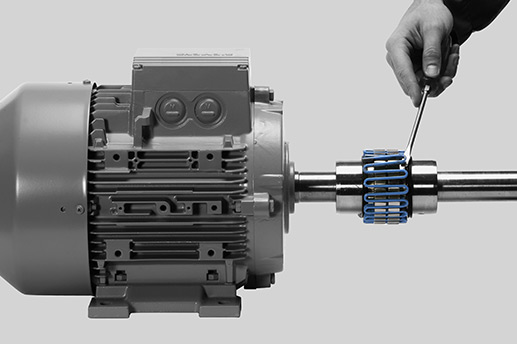
Couplings are used to connect driving equipment to driven equipment, making them a vital part of many power transmission systems. Despite their importance, couplings can sometimes be overlooked when it comes to correct selection and ongoing maintenance.
With so many coupling types available, it can be difficult to know which design is best suited to your application. Different couplings are built to handle different levels of torque, misalignment, vibration, shock loads, and precision.
Below is a practical guide to the main types of couplings, including how they work, their key benefits, and where they are commonly used.
Flexible Couplings
Flexible Couplings come in many different variations, but all of these have 1 thing in common – its elastomeric properties. Many use an elastomeric element, typically made from rubber, polyurethane, or a similar material, to absorb impact, dampen vibration, and cushion shock loads.
Because different applications place different demands on a drive system, flexible couplings are available in several designs, each offering specific performance benefits.
Jaw Couplings
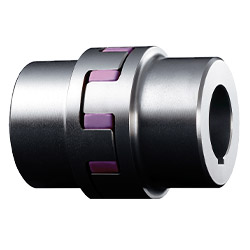
Jaw couplings are typically made up of two metallic hubs and an elastomeric insert, often referred to as a spider. The elastomer helps absorb vibration and shock, making jaw couplings a versatile option across many industrial applications.
A major advantage of jaw couplings is their fail-safe design. If the spider wears or fails, the hubs can continue to transmit torque for a limited period, although without the same damping performance. Jaw couplings also do not require lubrication, helping to reduce maintenance requirements and minimise downtime.
Tyre Couplings
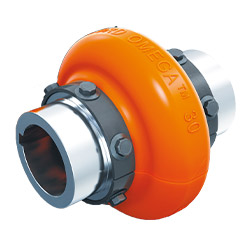 Tyre couplings consist of two metal hubs connected by a tyre-shaped flexible element. The tyre gives this coupling outstanding vibration dampening capabilities and excellent resistance to shock loads, helping to extend the life of the connected equipment in a wide range of industries.
Gear Couplings
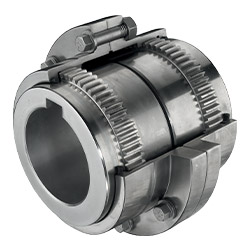
Gear couplings are designed for high torque transmission and are commonly used in demanding industrial applications. A typical gear coupling includes two hubs with external gear teeth, two sleeves or covers, and sealing components.
They are particularly suitable for low- to medium-speed applications where high torque capacity is needed.
Curved tooth gear couplings
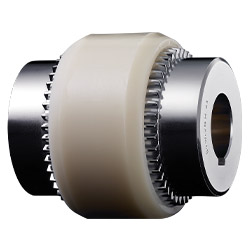
Curved tooth gear couplings are designed to improve alignment performance and reduce edge loading on the teeth. They are known for high torque capacity, reliable performance, and suitability for harsh environments.
Depending on the design, they can also offer easier assembly and reduced maintenance requirements. These couplings are commonly used in industries such as Minerals & Mills, Pulp & Paper, Petrochemical, Oil & Gas, Machine Tools and Railway.
Claw Couplings
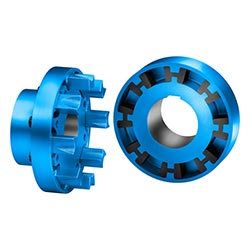
Claw couplings are another flexible, fail-safe option for applications where angular, parallel, or axial misalignment may occur. They are often compact in design, making them suitable where installation space is limited.
Their elastic element helps damp vibration and cushion shock loads, which can extend the service life of surrounding equipment.
Pin & Bush Couplings
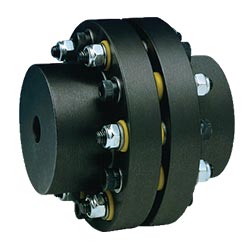
Pin and bush couplings are widely used in applications where vibration damping and shock absorption are required. They can also accommodate a 0.5° of misalignment while continuing to deliver reliable torque transmission.
This design helps absorb shock, reduce vibration, and protect surrounding drive components, making grid couplings a strong choice for heavy-duty industrial environments such as fire pumps, conveyors, and elevator drives.
Grid Coupling
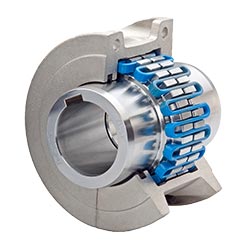
Grid couplings are ideal for applications subject to high levels of vibration or shock loading. They use a metallic grid element that fits between two slotted hubs, giving the coupling high torsional flexibility.
This helps to reduce vibration, which aids in prolonging the life of the surrounding drive equipment.
Back-lash Free Couplings
Back-lash free couplings are often found in applications where precision is key. Backlash is the small amount of lost motion caused by clearance between mechanical components, and in precision systems this can reduce positioning accuracy.
Using a backlash-free coupling helps improve control and responsiveness in servo-driven and motion control applications.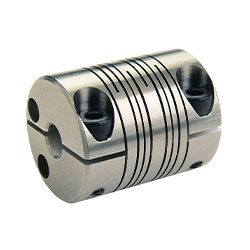
- Beam Couplings - Beam couplings are machined from a single piece of aluminium, stainless steel, or another metal. They offer torsional stiffness while compensating for minor misalignment, making them suitable for high-speed, high-accuracy applications.
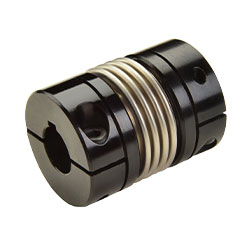
- Bellows Couplings – These couplings can flex while still being rigid under torsional loads, meaning it can accurately transmit velocity, angular position, and torque. It’s ability to flex also allows for parallel & angular misalignment and axial motion.
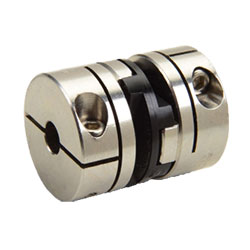
- Oldham Couplings – Oldham couplings are particularly effective where parallel misalignment is high. They are also highly adaptable, with different centre disc materials available to suit specific operating conditions. These couplings are commonly found in food and beverage, pharmaceutical, medical, and semiconductor applications.
Rigid Couplings
Rigid couplings are used where precise shaft alignment is already in place and a solid, positive connection is required. They are generally best suited to lower-speed applications or installations where misalignment is minimal.
Although simple in design, rigid couplings remain a cost-effective and dependable solution for many systems.
One piece, two piece and set screw rigid couplings
Rigid couplings are available in several designs, each with its own installation and performance advantages:
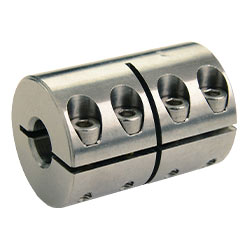 One-piece rigid couplings – offer strong holding power but usually require surrounding equipment to be moved for installation.
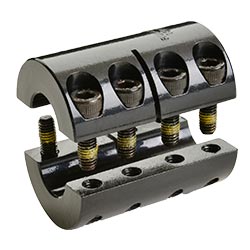 Two-piece rigid couplings – provide excellent holding power and are easier to fit and remove thanks to their split design.
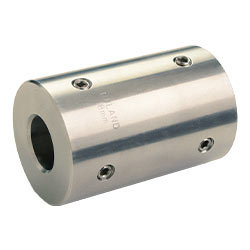 Set screw rigid couplings – are secured directly to the shaft using screws but may also require disassembly of adjacent equipment during fitting and removal.
Torsionally Rigid Couplings
Torsionally rigid couplings are designed to transmit torque with minimal wind-up, making them suitable for applications where positional accuracy and responsive power transmission are important. This category often includes disc couplings and composite couplings.
Depending on the design, torsionally rigid couplings can offer zero backlash, low restoring forces, and even electrical insulation.
Disc couplings
Disc couplings use one or more flexible metallic disc packs to transmit torque while accommodating misalignment. They do not require lubrication and are well suited to higher-speed applications where reliability and low maintenance are priorities.
Composite couplings
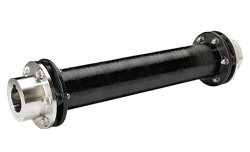 Composite couplings use advanced materials to achieve a balance of torsional rigidity, low weight, corrosion resistance, and electrical insulation. They are often selected for specialist applications where conventional metallic couplings may not be ideal.
Other Couplings
Some couplings do not fit neatly into a single flexible or rigid category, as their performance depends on the design and application.
Flywheel Couplings
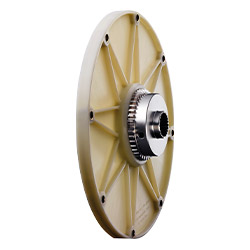 Flywheel couplings, sometimes referred to as flange-mounted couplings in certain applications, are often used where torsional rigidity and maintenance-free operation are required. They can be a good choice in systems where resonance control and reliable torque transmission are important, such as cranes, harvesting machinery, and conveyors.
Chain Couplings
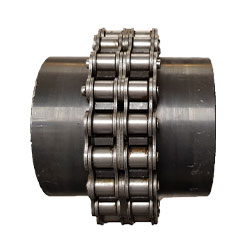
Chain couplings use sprocket-like hubs linked by a duplex roller chain. This gives them high strength and good torque transmission capability, while also allowing for 2° of shaft misalignment.
They are often used in robust industrial applications where durability is more important than precision.
Fluid Couplings
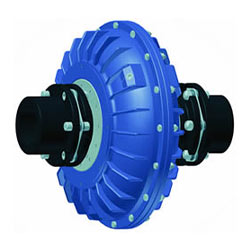
Fluid couplings are especially useful in applications where smooth start-up and vibration damping are required. By transmitting power hydraulically, they help reduce shock loading during start-up and protect connected equipment.
They are commonly used on conveyors, crushers, shredders, mills, and agitators, especially in harsh or heavy-duty environments.
Choosing the right coupling
Selecting the right coupling depends on several factors, including:
- torque requirements
- shaft size
- speed
- type and level of misalignment
- vibration and shock loads
- operating environment
- maintenance requirements
- need for precision or backlash-free performance
Choosing the correct coupling can improve performance, reduce wear, and help extend the life of your equipment.
Our specialised Couplings & Drives team can help you identify the best solution for your application, whether you need improved damping, higher torque capacity, backlash-free precision, or a low-maintenance design.
Get in touch with our team today to discuss your requirements.