

What do the different letters mean on a precision bearing?
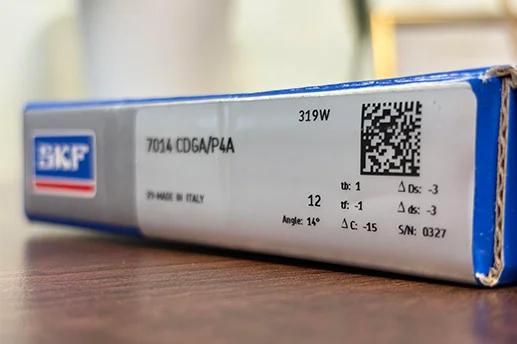
Precision bearings play a crucial role in keeping machinery running smoothly. If you’ve ever looked at a bearing and wondered what the markings mean, you’re not alone. These letters and numbers provide essential details about size, fit, and performance, so it’s essential to know exactly what they indicate.
Check out our range of precision bearings here
P4 or P3 – High Precision Rating
‘P4’ or ‘P3’ refers to the bearing's precision grade. The higher the grade (lower number), the tighter the tolerances, which means reduced vibration, better load distribution, and high rotational accuracy for smoother operation at high speeds. ‘P4’ & ‘P3’ bearings are commonly used in CNC machines, aerospace, and other precision applications.
D – Outer diameter
‘D’ stands for the outer diameter of the bearing. This measurement ensures the bearing fits properly in its housing or mounting location and aligns correctly with surrounding components. Proper alignment with surrounding components depends on this dimension, as even small deviations can affect machine performance, cause misalignment, or lead to premature wear.
d – Inner diameter
The lowercase ‘d’ refers to the inner diameter, the size of the bore where the bearing fits onto a shaft. This dimension is critical because it determines the bearing’s fit on the shaft, ensuring proper load distribution, stability, and efficient rotation. A correct inner diameter helps prevent slippage, excessive friction, or misalignment that could reduce efficiency and increase wear.
tf & tb - Ring Standout
‘tf’ & ‘tb’ refers to the inner and outer rings that stand out of a bearing. Bearing standout in precision bearings refers to the amount that the inner or outer ring of a bearing extends beyond the adjacent ring when mounted. This is particularly crucial in universally matched pairs, where the standout is precision ground to ensure that when two bearings are mounted directly next to each other, they achieve a specific preload without the need for further adjustment.
C – Width Variation
For precision bearings, ‘C’ indicates the width variation of the bearing from its intended size. Even tiny differences can affect how the bearing fits and performs, especially in high-precision machinery. This variation is carefully controlled to ensure bearings work smoothly, carry loads properly, and don’t create unwanted movement. This means it follows strict industry standards such as ISO 492 or ABEC/ISO tolerance classes to ensure bearings fit and function as expected, especially when used in pairs or sets.
Worked Examples
Reading a full designation left to right, applying the sections above, resolves most codes without needing to look anything up:
-
6205-2RS1/C3: a 6200-series (medium) deep groove ball bearing, bore code 05 giving a 25mm bore, sealed on both sides with rubber contact seals, manufactured to C3 internal clearance.
-
7210 ACD/P4A: a 7200-series angular contact ball bearing, bore code 10 giving a 50mm bore, in the ACD internal design variant, manufactured to SKF's P4A super-precision tolerance class.
-
22218 EK: a spherical roller bearing (22 prefix), bore code 18 giving a 90mm bore, in the E reinforced design variant, with a K tapered bore rather than a straight cylindrical one.
In each case, the letters after the core number are doing separate, specific jobs rather than modifying each other, which is the pattern worth carrying into any unfamiliar designation.
Why it matters
Understanding these markings helps you choose the right bearing for your application. Whether you’re selecting a replacement or designing from scratch, knowing what each letter means ensures a precise fit and smooth performance. At ACORN, we make it easy to find the right bearing, because when everything fits perfectly, your machinery runs at its best. Talk to our product experts for assistance with selecting the best product for your application.
Frequently Asked Questions
What does the letter C mean on a bearing?
The letter C followed by a number identifies the bearing's internal clearance class, such as C2, C3, C4 or C5, describing how much the rings can move relative to each other before the rolling elements take up load. It does not describe a width tolerance. C3, greater than Normal clearance, is the most common class for electric motors and similar applications with interference fits.
Is P3 a real bearing tolerance class?
No. ISO 492 defines Normal (P0), P6, P5, P4 and P2, with no standard P3 class. Some manufacturers do publish their own branded intermediate classes, such as SKF's P4A or P4C, which combine a standard tolerance with tighter running accuracy for a specific bearing range, so a designation showing something outside P0/P6/P5/P4/P2 is worth checking against that manufacturer's own catalogue rather than assumed to be a typo or a standard class.