

What is Preloading a Bearing? (And How to Preload One Correctly)
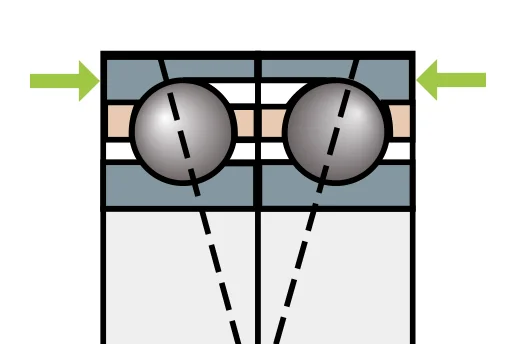
A standard bearing is built with a small amount of internal clearance, the tiny gap between the rolling elements and the raceways that lets the balls or rollers move freely. Preload removes that gap on purpose. An axial or radial force is applied to the bearing during mounting so the rolling elements sit under a fixed, predetermined load rather than free play, which is why preload is often described as negative internal clearance.
The force comes from within the bearing arrangement itself, not from the machine's operating load. Once set, it stays in the bearing whether the shaft is turning or standing still.
SKF's own bearing selection guidance gives a working estimate for the size of that force in small electric motors: preload force F equals a factor k multiplied by the bearing bore diameter d, with k typically between 0.005 and 0.01. Where the main job of the preload is to stop the bearing rattling around when the motor is stationary, SKF recommends raising k to 0.02. That single formula is a useful way to see what preload actually is: a calculated, deliberate load, not a side effect of tight tolerances.
Bearings that run without enough preload, or with too much, rarely fail cleanly. Instead they run hot, run loud, or lose the positioning accuracy the application was specified for in the first place, which is why getting this one setting right matters more than its size suggests.
What Is Preloading a Bearing?
Bearing load refers to the forces a bearing experiences during operation, and every bearing type is rated to handle a specific range of them. Preload sits apart from that operating load. It's a predetermined internal force, applied deliberately during mounting, that pushes the rolling elements against both raceways at the same time and removes the clearance a standard bearing is built with.
Why Apply a Preload?
Preload is most common in high-precision applications such as machine tool spindles, aerospace actuators and robotics, where a fraction of a millimetre of unwanted movement is enough to affect the finished part or the positioning accuracy of the machine. The benefits scale with how demanding the application is:
-
Enhanced stiffness, reducing deflection under load and improving the rigidity of the whole shaft assembly.
-
Reduced noise, since eliminating internal clearance stops the rolling elements moving around inside the bearing, particularly at high speed.
-
Improved shaft guidance, preventing unwanted axial and radial movement so the shaft holds its position under varying load.
-
Longer service life, because minimising internal play reduces the wear caused by repeated small impacts between rolling elements and raceways.
-
Better running accuracy, giving the positioning precision that grinding spindles, robotic joints and measuring equipment are specified to deliver.
-
Reduced skidding risk, keeping rolling elements in constant contact with the raceway during rapid acceleration, deceleration or very light loading, when they would otherwise be prone to sliding rather than rolling.
Preload in Angular Contact Ball Bearings
Single-row angular contact ball bearings are almost always mounted in pairs to achieve preload, in either a back-to-back or face-to-face arrangement. Back-to-back pairs sit further apart at the pressure centres, which gives them a greater ability to resist tilting moments; face-to-face pairs sit closer together and are more compact.
For applications where precision matters most, manufacturers supply matched or universally matchable pairs that are ground to a specific stand-off before they leave the factory, so the correct preload is achieved automatically once the pair is clamped together, with no shimming or adjustment needed on assembly. These matched sets are typically graded by preload class, light, medium or heavy, so the class ordered already reflects how much rigidity the application needs. Interference fit and operating temperature still affect the final preload once the bearing is running, so the class specified at the design stage should account for expected thermal growth, not just the static, cold assembly figure.
Find out more about the different bearing arrangements
Preload in Cylindrical Roller Bearings
Cylindrical roller bearings can only be preloaded radially, and only when they have a tapered bore. The inner ring is driven up a tapered shaft or sleeve rather than heated onto a cylindrical seat, which creates an interference fit that expands the ring and generates the required preload directly.
The amount of preload is set by how far the ring travels up the taper, not by a target temperature, so it's measured as a reduction in radial internal clearance or as an axial drive-up distance using an internal clearance gauge. This is a precise, incremental process. Overtightening the drive-up distance by even a small amount can push the bearing well past its intended preload and into the excessive preload symptoms covered below.
How to Preload a Bearing
There are two established ways to apply preload, and the choice depends on whether the application needs preload to stay fixed or to stay constant as the machine heats up.
Fixed Position Preload
Fixed position preload sets the axial position of the bearing rings relative to each other using a spacer, shim or a matched, pre-ground bearing set, then clamps that position in place with a locknut or end cap. Once assembled, the preload is fixed at whatever value the spacer width or the matched set's ground stand-off produces. This method gives the highest stiffness and is the standard choice for machine tool spindles and gearboxes, but the preload will rise as the shaft and housing expand at different rates under heat, so the spacer or shim dimensions need to account for the expected thermal growth in the application.
Constant Pressure Preload
Constant pressure preload uses a spring, most commonly a wave spring, coil spring or Belleville washer, acting on the outer ring of one bearing in the pair. The spring maintains a near-constant force even as the bearing shifts slightly with thermal expansion, which is why it's the standard method for small electric motors and other applications where preload is mainly there to control noise and prevent skidding rather than to deliver maximum stiffness. It isn't suitable where a high degree of stiffness is required or where the direction of axial load reverses.
Whichever method is used, proper handling during assembly is essential. Internal clearance gauges should be used to verify the fit is correct before the bearing goes into service, since incorrect preload set at the mounting stage cannot be corrected later without dismantling the assembly.
How Much Preload Does a Bearing Need?
The correct preload value depends on the bearing size, type and application, and manufacturers publish empirical values for proven designs that can be applied to similar setups. For a new design, SKF recommends calculating the target preload range using its SimPro Quick or SimPro Expert software, then confirming it with testing in the actual application, since the agreement between a calculation and the real result depends on how closely the estimated operating temperature and the elastic behaviour of the housing match reality.
For small electric motors specifically, SKF's published estimate is:
F = k x d
Where F is the preload force in kN, d is the bearing bore diameter in mm, and k is a factor typically between 0.005 and 0.01. Where the preload exists mainly to protect the bearing from vibration damage while the shaft is stationary, SKF recommends increasing k to 0.02.
Preload can be checked once assembled by measuring the frictional torque needed to rotate the shaft, by measuring axial displacement under a known load, or, in matched sets, by simply confirming the correct class of bearing was fitted.
Signs of Incorrect Preload
Incorrectly preloaded bearings rarely fail without warning. The two failure modes point in opposite directions, which makes them straightforward to tell apart once you know what to check.
Excessive preload drives up friction and heat inside the bearing, which degrades the lubricant and, once the grease has broken down, accelerates wear on the raceways themselves. The typical progression is thermal expansion, then higher running torque, then fatigue and premature failure, so a bearing running consistently hotter than expected under a fixed load is worth checking for over-preload before anything else.
Insufficient preload leaves clearance in the bearing that shows up as vibration, noise and play under light or reversing loads. In practice, this often means skidding, the rolling elements sliding rather than rolling across the raceway, which fretting-corrodes the raceway surface and wears the bearing faster than normal rolling contact would. If a precision application starts running louder or less accurately without an obvious external cause, insufficient preload is a reasonable first check.
Getting Preload Right
For applications that depend on precision, whether that's a grinding spindle, a robotic arm joint or a small electric motor, the correct preload is not a rounding error. Too much reduces service life through heat and fatigue; too little reintroduces the vibration, noise and skidding that preload was meant to eliminate in the first place.
If you're specifying a bearing arrangement for a new application, our guide on choosing the right super precision bearing covers selection in more depth, and our team can advise on matched sets, preload class and mounting method for your specific shaft and housing tolerances.
Contact us today for expert advice on getting preload right the first time.
Frequently Asked Questions
What is preloading a bearing?
Preloading a bearing means applying a predetermined axial or radial force to the bearing during mounting, so the rolling elements sit in constant contact with both raceways rather than moving within the small clearance a standard bearing is built with. It's often described as negative internal clearance, and the force comes from the mounting arrangement itself, not from the load the bearing carries once the machine is running.
How do you preload a bearing?
There are two main methods. Fixed position preload uses a ground spacer, shim or a matched bearing pair to set a specific axial position that's then locked in place, giving high stiffness but a preload that changes slightly with temperature. Constant pressure preload uses a spring or wave washer to apply a near-constant force that adjusts automatically as the bearing shifts with thermal expansion, which suits motors and lighter-duty applications better than high-stiffness ones.
What's the difference between bearing clearance and bearing preload?
Clearance is the small internal gap built into a standard bearing that allows the rolling elements to move freely between the inner and outer raceways. Preload removes that gap and goes further, applying a fixed compressive force that holds the rolling elements against both raceways at once. Preload is sometimes described as negative clearance for this reason.
What happens if a bearing has too much preload?
Excessive preload increases friction and heat inside the bearing, which degrades the lubricant and leads to higher running torque, thermal expansion and fatigue. Left uncorrected, it shortens bearing life significantly compared to a bearing running at its intended preload.
What happens if a bearing doesn't have enough preload?
Insufficient preload leaves internal clearance in the bearing, which shows up as vibration, noise and imprecise operation. It also increases the risk of the rolling elements skidding rather than rolling under light or reversing loads, which causes fretting on the raceways and accelerates wear.
What is a matched bearing set, and what do the letters DB, DF and DT mean?
A matched set is a pair of angular contact ball bearings ground together at the factory to a specific stand-off, so the correct preload is achieved automatically once mounted, without shims or adjustment. DB denotes a back-to-back pair, DF a face-to-face pair, and DT a tandem pair used to share load rather than to generate preload. Sets are also commonly supplied in light, medium or heavy preload classes to match the application's stiffness needs.
How much preload should a bearing have?
It depends on the bearing size, type and application, and manufacturers publish empirical values for proven designs. As a working estimate for small electric motors, SKF's guidance gives the preload force as F = k x d, where d is the bore diameter in mm and k is typically 0.005 to 0.01, rising to 0.02 where the preload's main job is preventing movement while stationary. For anything outside that scope, checking the manufacturer's specific guidance or having the arrangement calculated is the more reliable route.
Does every bearing need to be preloaded?
No. Preload is applied where an application specifically needs the stiffness, positioning accuracy or noise reduction it provides, typically in precision machinery, spindles and small motors. Most standard industrial bearing arrangements are designed to run with a small amount of clearance instead, and preloading them unnecessarily would only add cost and the risk of getting the value wrong.