

Why Do Super Precision Bearings Fail?
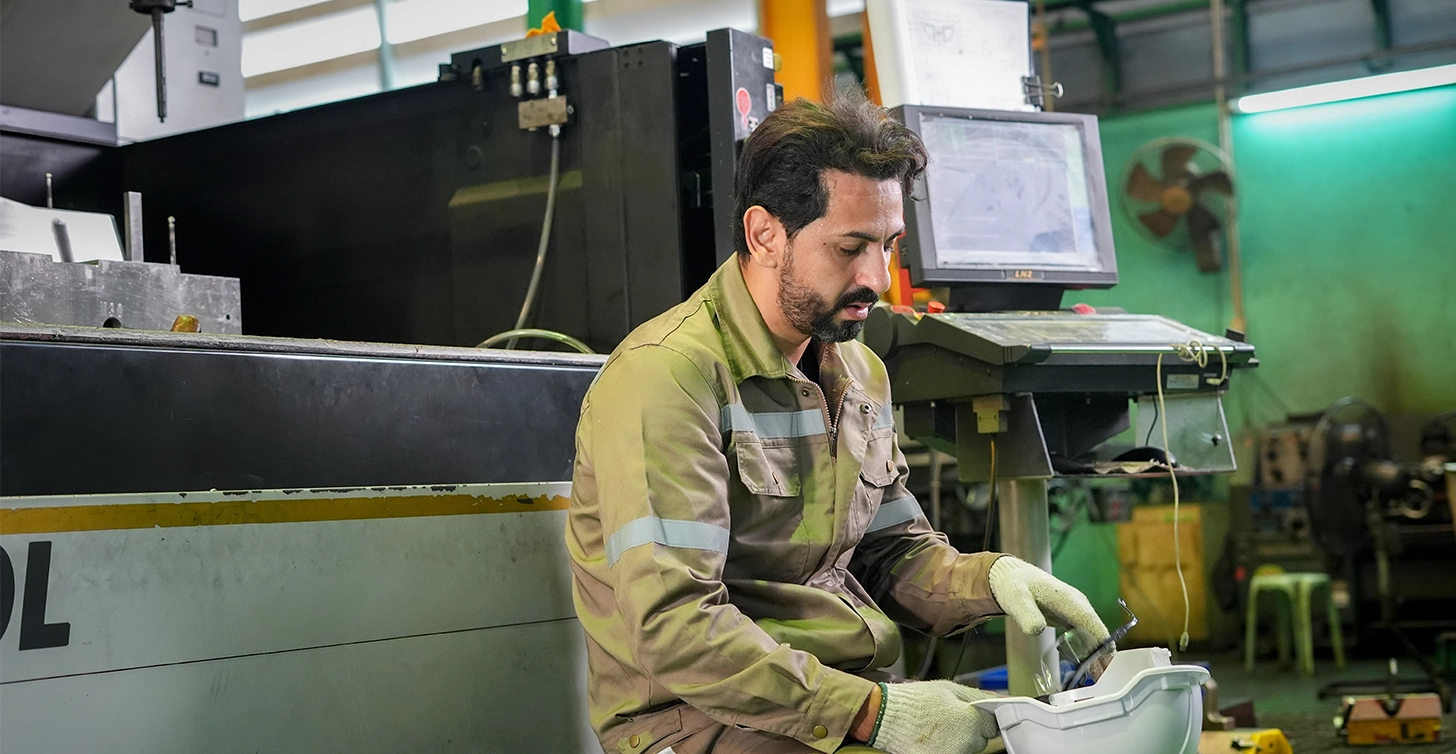
Super precision bearings are designed to deliver exceptional accuracy, stiffness and performance at high rotational speeds. They are commonly used in machine tool spindles, grinding machines, high-speed motors and other equipment where even a small amount of vibration or runout can affect the finished product.
That precision also means there is less room for error. A bearing can be perfectly manufactured yet still fail prematurely if it is incorrectly specified, fitted, lubricated or operated outside its intended conditions. Failed spindle bearings can cause poor surface finishes, reduced machining accuracy and unplanned downtime. If the problem is not identified early enough, it may also damage the spindle, housing or other associated components.
The good news is that premature failure is often preventable. Understanding the most common causes can help maintenance teams protect bearing performance and extend the working life of their precision machinery.
1. Incorrect bearing arrangement
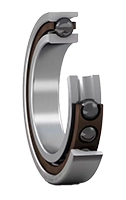
Super precision bearings are commonly installed as matched pairs or sets. The arrangement affects how the bearings share load, support the spindle and resist movement under cutting forces.
Back-to-back, face-to-face and tandem arrangements each have difference strengths. Each arrangement offers a different benefit, whether it be high rigidity, tolerating misalignment, or sharing load across bearings.
What are the different bearing arrangements and where are they used?
If the arrangement does not suit the application, loads may not be shared evenly between the bearings. This can lead to excessive deflection, vibration, uneven raceway loading and early fatigue. In a machine tool spindle, it may also affect the accuracy and finish of the component being machined.
Assess the axial and radial loads, required spindle stiffness, operating speed and whether load acts in one or both directions. Matched sets should remain together, as mixing bearings from different sets can alter preload and load distribution.
2. Lubrication issues
Lubrication is one of the most important factors in bearing life. It creates a protective film between the rolling elements and raceways, reduces friction and helps remove heat from the bearing.
Using the wrong grease or oil can quickly undermine performance. A lubricant suited to a slower application may increase resistance in a high-speed spindle, while an oil with insufficient viscosity may not maintain an adequate lubricating film.
The quantity is just as important as the lubricant itself. Too little lubricant can allow metal-to-metal contact, causing wear and temperature rise. Too much grease can cause churning, where the rolling elements repeatedly work through excess lubricant. This increases friction and heat, which can reduce grease life and restrict the spindle’s maximum speed.
Contamination is also closely linked to lubrication failures. Fine dust, water and cleaning fluids can enter through ineffective seals, poor storage or careless handling. Even a small hard particle can indent a raceway and develop into flaking.
Premium bearing manufacturers identify lubrication and contamination as one of the most significant general causes of bearing damage. This makes it essential to keep lubricants in sealed, clean containers, use dedicated application equipment, and leave bearings in their original packaging until installation.
3. Incorrect fits/tolerances
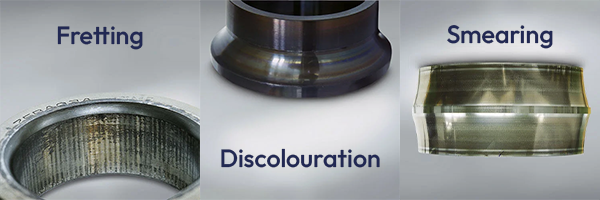
The fit between the bearing, shaft and housing has a direct effect on internal clearance and preload. If a shaft or housing fit is too tight can compress the bearing rings and increase preload beyond the intended level. This raises friction and operating temperature, and may lead to smearing, discolouration or seizure.
If the fit is too loose, the bearing ring can creep on its seating. This movement may cause fretting corrosion, wear and reduced running accuracy. A loose fit can also make it harder to maintain a consistent preload during operation.
For super precision bearings, it is not enough for the shaft and housing to be the correct nominal size. Their roundness, cylindricity, surface finish and axial runout must also be suitable. A high-precision bearing mounted on an inaccurate seating cannot perform as intended.
Always inspect the shaft and housing when replacing a bearing. Wear, corrosion, ring creep or removal damage may have changed their dimensions. Select the fit using the manufacturer’s guidance and the application’s load, speed and temperature conditions.
4. Misalignment
Misalignment causes rolling elements to run outside their ideal contact path. Instead of spreading the load evenly across the raceway, the load becomes concentrated towards one side of the bearing.
This can create high edge stresses, vibration, uneven raceway marks and premature fatigue. Even minor misalignment can contribute to excess runout, tool wear and poor surface finish.
It may be caused by an inaccurate shaft or housing shoulder, contamination between mounting faces, spindle deflection, a distorted housing or poorly aligned driven equipment. When investigating repeat failures, check the complete system, including spindle runout, shaft straightness, housing alignment, and mating surfaces.
5. Excessive temperature
Heat is both a common cause of bearing damage and an important warning sign. When a bearing operates above the temperature it was designed for, its lubricant can break down quicker, seals and cages may deteriorate, and the internal operating clearance can change.
Temperature also affects preload. A spindle that seems correctly preloaded when cold become too tight once the shaft, housing and bearing rings expand at different rates. Higher preload creates more friction, which generates more heat and can accelerate the problem.
Common causes include excess grease, unsuitable lubricant, inadequate cooling, excessive speed, overly tight preload or poor heat transfer through the housing. Investigate any sustained rise from the machine’s normal temperature baseline.
Hybrid bearings with ceramic balls can be beneficial in some high-speed applications. Their lower mass can reduce centrifugal forces and heat generation, and they can offer useful electrical insulation properties. However, ceramic balls are not always a simple cure for an overheating spindle. Bearing arrangement, preload, lubrication, cooling and fits must all be correct.
6. Installation and handling damage
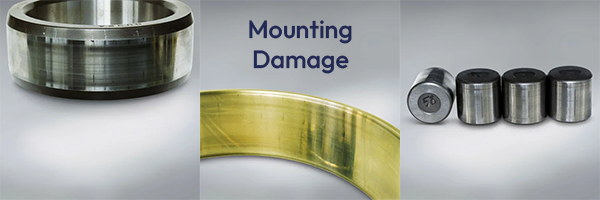
A precision bearing can be damaged before it has completed a single operating cycle. Poor fitting is widely recognised as a significant cause of premature bearing damage, with industry estimates often attributing around 16% of early failure to incorrect installation.
Hammering a bearing into place, or applying mounting force through the rolling elements, can leave dents in the raceways. These indentations may be difficult to see, but they disrupt smooth rotation and can develop into noise, vibration and early fatigue once the bearing is in service.
Dropping a bearing, striking it against a hard surface or allowing dirt to enter during assembly can have the same effect. Improper removal can also damage the shaft, housing or bearing seating.
Install bearings in a clean, controlled environment using appropriate mechanical, hydraulic or thermal fitting tools. Apply force only the ring being fitted. When fitting onto a shaft, for example, apply force to the inner ring, not through the balls to the outer ring. Keep bearings in protective packaging until immediately before use.
7. Operating beyond the bearing’s speed/load
Every precision bearing has limits for speed, radial load, axial load and operating temperature. Running a spindle beyond these limits, whether continuously or during occasional heavy-duty cycles, can significantly shorten bearing life.
Excessive radial or axial load can permanently deform rolling elements and raceways, increase contact stressed and lead to premature flaking. Unexpected cutting forces, tool crashes, poor balancing or a change in process can all overload the spindle.
Preload is especially important in precision applications. Too much preload increases stiffness, but it also increases friction and operating temperature. Too little preload allows unwanted movement, vibration and, at high speed, skidding of the rolling elements. Both conditions can affect accuracy and cause premature damage.
Preventing repeat precision bearing failures
When a super precision bearing fails, replacing it is only part of the solution. Examine the failed bearing alongside the lubricant, seals, shaft, housing and operating conditions. Raceway markings, discolouration, vibration trends and temperature history can all provide useful clues.
Identifying the root cause early helps avoid secondary damage and allows maintenance to be planned before a complete breakdown. With the right arrangement, clean lubrication, accurate fitting and appropriate operating conditions, super precision bearings can deliver the reliability and accuracy that precision machinery depends on.
If you’re unsure about what may be causing issues with your super precision bearing arrangements, get in touch with our dedicated team today.