

The Basics of Needle Roller Bearings
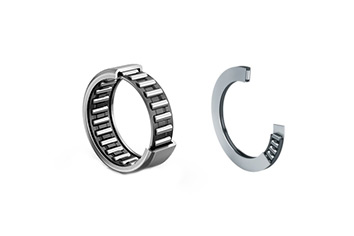
Needle Rollers are a small cylindrical type of bearing, which are used to prevent friction between moving surfaces which have low rotational speeds. Needle Rollers are usually used when space is at a premium, as they are more compact than ball bearings.
According to Marks' Standard Handbook for Mechanical Engineers, “A Needle Bearing is a roller bearing with rollers whose length are at least four times their diameter”.
The high speeds at which Needle Rollers can operate mean that they are usually lubricated with grease or oil. Depending on the demands of the application, high speeds or heavy loads may mean that the bearings would need regular coats of lubrication.
As needle rollers can reach such high speeds, the retainers are vital in preventing any friction between the needles, whilst helping to make the needles more stable.
Although there is a wide range of designs available for needle rollers, the typical bearing features an inner race and outer race, a cage which contains the needle rollers and the actual needle rollers.
In some cases, needle bearings can be used without an inner race or an outer race, as the needle rollers in the bearings can operate alone. For needle rollers to be effective, the hardness, accuracy, and finish of the shaft must have exactly the same qualities as the bearing races.
Due to the small size of needle rollers and the high speeds they are able to rotate at, they are used in compact mechanisms such as gearboxes. For example, in an average car, the drive shaft will usually have eight or more needle rollers in it.
Other uses for these bearings include small appliances, robotics, aircraft control, farm equipment and construction equipment.