

How to Find the Right Size Roller Chain When the Transmission Chain has Stretched
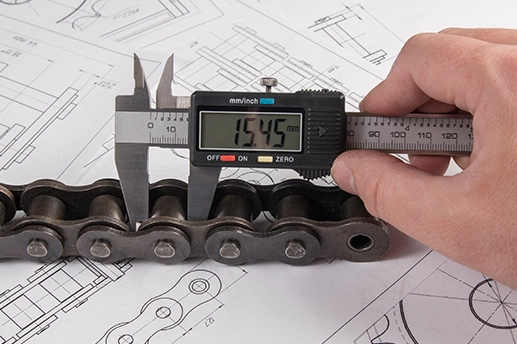
If your roller chain is worn or stretched, figuring out the correct replacement can feel daunting. But with a straightforward approach and the right tools, you’ll be back on track in no time.
To break it down clearly: most roller chains in use today fall into one of two standard types – British Standard (BS) or American Standard (ANSI). Knowing which standard you’re working with makes the process easier. Each uses its own sizing system, but the measurements you need to identify them are universal.
Click here to buy Roller Chain
Components of a roller chain
Before we jump into measurements, we should define each of the components within a roller chain.
-
Pin Link Plate: An outer plate on the pin link of the roller chain, which typically comes in a figure-8 shape or straight.
-
Roller Link Plate: The inner play on the roller link of the roller chain. Typically straight or figure-8 shaped.
-
Roller: Rotates on top of the bushing on the roller link.
-
Pin: Press fit into the pin link plate. Bisects the bushings in the roller link.
-
Bushing: Press fit into two roller link plates. It is bisected by the pin in the pin link.
Each piece of the roller chain fits very precisely, which is why every component of the roller chain must be measured to help identify it.
What you will need to measure:
You’ll need a couple of basic tools:
- Vernier calliper
- Wear gauge
Three Key Dimensions
Like many things within the engineering and power transmission world, three main dimensions can get you close to identification.
For example, with bearings, you measure the Inner diameter, outer diameter and width, whereas v and wedge belts are measured by the top width, depth, and length. Chain is no different; there are three dimensions to look at:
Pitch
This is the distance between the centres of two adjacent pins.
- Tip: The pitch determines the chain’s size class, so get this one as accurate as possible.
Roller Diameter
Measure the diameter of the roller that engages with the sprocket itself.
- Tip: Measuring the roller helps confirm the pitch and avoids confusion with worn or non-standard chains.
Inner Width
Measure the internal width between the inner plates across the roller. This helps determine how the chain fits with your sprockets.
- Tip: If your chain doesn’t have rollers (roller-less chain), the inner width becomes the defining measurement alongside pitch.
Step-by-step Guide to Measuring Your Chain
Step 1: Check for Markings First
Most chains are stamped with their size on the outer plate, usually at regular intervals. For ANSI chains you might see 40, 50, or 60, and for BS chains, look for 08B, 10B, etc.
- 08B-1 – Simplex (single strand)
- 08B-2 – Duplex (double strand)
- 08B-3 – Triplex (triple strand)
- … and so on, up to 08B-10 – Decaplex
Step 2: Measure the Roller Diameter
Using your vernier calliper, measure the diameter of one of the rollers. It’s a quick and accurate first step and helps cross-reference with the pitch.
Step 3: Measure the Chain’s Pitch
Measuring the pitch directly across pins can be awkward, especially if the chain is still installed. Here’s a reliable workaround:
- Measure the total distance from the outside of one roller to the outside of the next (i.e., across two rollers).
- Subtract one roller diameter from this total.
- What you’re left with is your pitch, the centre-to-centre distance between pins.
- Example: If the total distance across two rollers is 21.21 mm, and the roller diameter is 8.51 mm, the pitch is 21.21mm – 8.51mm = 12.7mm (which corresponds to an 08B chain).
Step 4: Measure the Chain Inner Width
Now measure the space between the two inner link plates, this is your inner width. Take this measurement at the roller, across the inside faces of the plates. It helps match the chain to the right sprocket and ensures proper fit.
Why Accurate Chain ID Matters
Getting the chain size right the first time means no wasted time ordering and returning the wrong part, reducing the risk of downtime and ensuring proper sprocket engagement, leading to a longer lifespan for your drive systems.
Remember - if the chain has stretched beyond acceptable limits, even a perfect re-lube won’t save it. Replacing it quickly with the correct size ensures continued performance and safety.
Compare Measurements to Charts

Common Chain Measurement Errors
It can be easy to make mistakes when measuring up your chain. Consider the following points to avoid them:
-
Avoid measuring a twisted or curved chain, as this can shorten the apparent length, which can lead to incorrect sizing.
-
Don’t ignore internal spacing.
-
Don’t ignore link thickness.
-
Rounding measurements can cause problems. Only round if absolutely necessary and stick to exact measurements where you can.
Resolving a wrong chain measurement
If you suspect an error, consider measuring the chain with a different tool or method. By comparing different measurements, you can spot any inconsistencies.
Check and double-check
Be sure to compare your measurements to the manufacturer's charts or specifications before buying a replacement chain. If you are unsure, visit your local Acorn Industrial Solutions store to see if you can test-fit the chain.
Talk to the Experts at Acorn Industrial Services
Even with measurements sorted, chain identification can sometimes be tricky, especially if you’re dealing with an unusual setup, heavy wear, or a modified system.
Send us a photo of your chain alongside your measurements or bring a sample into your local ACORN branch. Our team of power transmission experts are on hand to help you identify your chain quickly and accurately and get the replacement to you fast.
Frequently Asked Questions About Measuring Chain
How do you measure chain size accurately?
In short, measure the length, link width, thickness, and internal spacing to ensure you have all bases covered when measuring your chain.
What is the easiest way to measure a chain?
The easiest way to measure the chain is, if possible, to lay it flat and use a measuring tape for the length. For link dimensions, consider using callipers.
Why can chain size feel different even when it’s the same length?
Chain sizes can feel different when used or worn. Link styles, thickness and spacing can also play a role in making chain sizes feel different.
How to measure chain size
To measure chain size, collect the following measurements:
-
Measure the chain length from one end to the other when laid flat.
-
Measure link width.
-
Measure the link thickness.
-
Measure internal spacing.
How to measure chain pitch
-
Identify the pin of your chain.
-
Measure from the centre of the pin to the centre of the next pin in line.
Or if the chain is still installed, consider:
-
Measuring the total distance from the outside of one roller to the outside of the next (i.e., across two rollers).
-
Subtract one roller diameter from this total.
-
You now have the pitch.