A Ball Screw is a highly efficient method of converting rotary to linear motion. Ball screw actuators can move heavy loads at high speeds and accommodate high thrust loads. Ball screws comprise a threaded shaft and a nut containing a ball-bearing mechanism.
The balls contact the shaft raceway and recirculate, propelling the nut along the shaft in a smooth, precise movement with minimal internal friction. Ball screws are manufactured to close tolerances and are available in standard and miniature designs. Ball screw nuts and threaded shafts are also available to purchase separately.
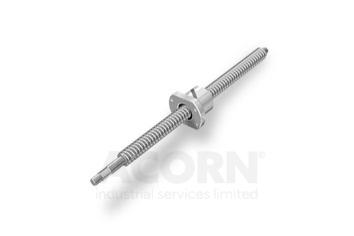
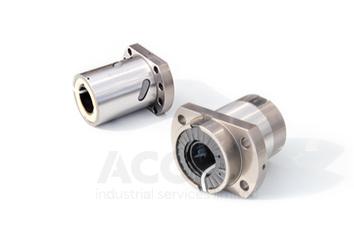
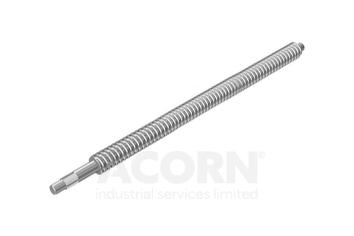
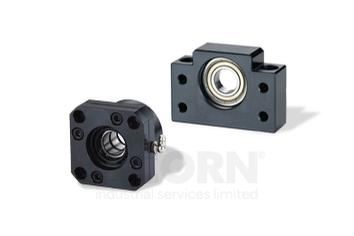


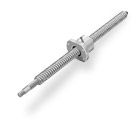
Ball screws utilise ball bearings recirculating within a nut, which transmit the load to the shaft. They are a very efficient method of converting rotary motion to translational movement.
There are two main types of ball screws ~ rolled and ground. With the advent of precision rolling technology, most ball screws are now of the rolled type, as these can offer up to G5 lead precision and excellent running characteristics. For applications with higher accuracy requirements or specific preloads/axial clearances then, ground ball screws are used.
SKF has an extensive range of precision rolled ball screws, including miniature ball screws (available in stainless steel). SKF SD, BD, SH, SX, BX, SND, BND, PND, SN, BN, PN, SL, TL, SLT and TLT are all available from Acorn.
THK offers a vast range of both rolled and ground products, with rolled products being manufactured in Europe. DIN standard EBA, EBB, EBC, EPB, EPC and EPA ball screws are available.
Both THK and SKF offer a range that includes long lead ball screws and rotating nut ball screws.
As all ball screws can only ‘see’ axial forces then some form of linear guidance is usually required; shafts, linear profile rail guides and roller guides are all available from Acorn ~ please see the relevant product pages for details.
Due to the high precision, efficiency, and load handling capacity, ball screws find applications in many industries. The application involves:
CNC Machinery: In converting motor rotation into accurate linear motion for milling, drilling, cutting, etc.
Robotics and Automation: To provide accurate control of robotic arms and automation systems.
Aerospace: Aircraft systems—flaps, landing gears—where the ability to withstand heavy loads reliably is required.
Medical Devices: Applied in MRI machines, surgical robots and patient beds for smooth and precise operation
Automotive: Applied in electric steering systems, automotive assembly lines
Packaging and Printing: Controls the movement of print heads and packaging machinery to ensure precision at speed
Semiconductor Manufacturing: Providing micrometre-level positioning for wafer handling and lithography processes.
At Acorn Industrial Services, we can offer ball screws to suit your automation project, as well as spare or replacement units. We are committed to providing other linear motion products to meet your industrial needs, from components through to full automated systems:
Contact us now for support from our Ball Screw experts.
Acorn Industrial Services is proud to have brick & mortar branches across the United Kingdom, allowing you to receive vital advice in-person or remotely from your local experts. Discover your nearest branch for support on ball screws today.
Acorn Industrial Services is one of the UK’s leading suppliers of industrial components, with a team of experts, ready to provide advice on ball screws alongside our broader selection.
Need support? Our specialists are available for all your needs. Check out our reviews for more information.
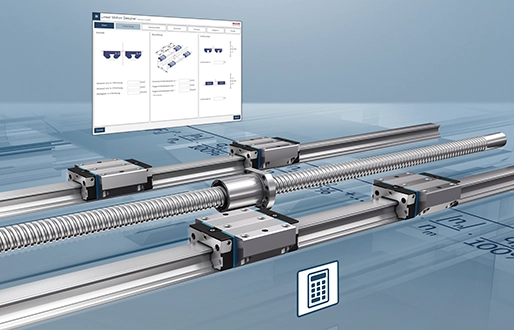
A ball screw is used to convert rotary motion into linear motion with high precision and efficiency. It is commonly employed in machinery like CNC machines, robotics, and automotive applications to achieve accurate linear movement.
The weight a ball screw can hold depends on its design, material, and size. Ball screws can typically support heavy loads, ranging from a few kilograms to several tonnes, depending on the specific application requirements.
Ball screws possess very high reliability and prove their value by precision, effectiveness, and durability. They can keep performing predictably over very long periods of operation, even in high-stress conditions, with proper maintenance that includes regular lubrication and inspection.
Most ball screws incorporate some form of locking, such as a brake or anti-backlash device, that prevents screw movement when power is removed. This is particularly necessary in applications where a position must be held without power.
Ball screws are not self-locking, meaning they will backdrive under reverse loads, unless fitted with an external braking system
Lubrication is critical to the everyday functionality and life span of bearings. Whilst ball screw actuators are often shipped with a rust preventative applied to their surface, this is not sufficient lubrication for everyday use. Due to the movement which ball screws experience, lubrication should be applied thoroughly and regularly.