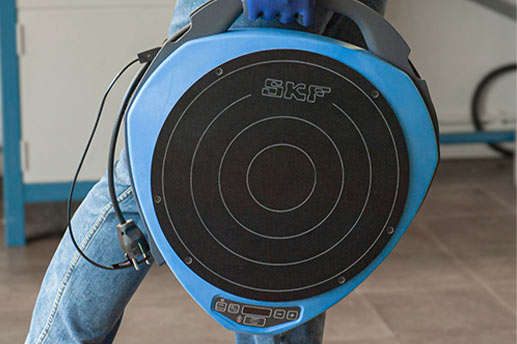
When to Use a Bearing Heater (And When Not To)
Heat expands the inner ring of a bearing just enough to slide it onto a shaft without force. That's the entire mechanism behind bearing heating, and it's why heat is one of the most reliable bearing mounting methods available.
But being reliable doesn't always mean it’s the best method for your needs.
According to SKF's own maintenance and lubrication catalogue, around 16% of all premature bearing failures are caused by poor fitting, usually brute force or the wrong mounting method for the job. Knowing when to use a bearing heater, and when a different method is actually the better choice, matters as much as knowing how to use one.
Oil bath, open flame, a mounting kit, brute force with a hammer: there's no shortage of ways to get a bearing onto a shaft, and not all of them belong in a modern maintenance routine. Heat is one of the more effective methods precisely because it's controllable in a way a naked flame or a hot oil tank never quite is.
In this article, you’ll find the information you need to help you make the right decision, from the bearing sizes and seat types, the situations where cold or hydraulic mounting is the smarter option, and the exact temperature thresholds that SKF publishes to get it just right.
If you want the full comparison of mechanical, heat, and hydraulic mounting side by side, our article on How to Fit a Bearing covers that ground. This article goes deeper on the heat method specifically.
When should you use a bearing heater?
The force needed to mount a bearing cold rises sharply with bearing size. For small bearings, that force is manageable with a fitting tool kit. Past a certain point, it isn't, and heat becomes the practical choice rather than an optional upgrade.
SKF's own maintenance and lubrication catalogue classifies bearing size by bore diameter, not outer diameter, which is the detail worth getting right before deciding on a method:

Heat mounting works across this entire range in principle. What changes is whether it's the sensible choice. Below roughly 55mm bore, the mounting force is low enough that a mechanical fitting tool kit does the job quickly and without the setup time a heater requires.
Above 55mm, as the interference fit and the required force both increase, heat becomes the more practical route, particularly for bearings in the medium-to-large bands, where cold mounting risks driving the force through the rolling elements rather than the ring with the interference fit.
On seat type, heat mounting is specific to cylindrical-bore seats. If the bearing has a tapered bore, the mounting method changes entirely, which is the first case covered below.
In practice, this makes heat mounting the standard method across a wide range of maintenance and production environments. Electric motor rewinds, pump and gearbox overhauls, and conveyor and fan bearing replacements, all of which typically involve bearings in the medium-to-large bands, are mounted on straightforward cylindrical shafts.
It's also the method of choice for large-bore bearings in wind turbine main shafts and heavy rotating equipment, where the interference fit is substantial and cold mounting isn't a realistic option.View the full range of bearing heaters here
When a bearing heater isn't the right choice
Heat mounting is the right method for a large share of bearing installations, but not all of them. Three situations call for something else.
Tapered-bore bearings
Bearings with a tapered bore, such as double-row self-aligning ball bearings, CARB toroidal roller bearings, and spherical roller bearings, achieve their interference fit by being driven up the tapered seat rather than expanded and slid into place.
The degree of interference is set by how far the bearing travels up the taper, measured as a reduction in radial internal clearance or an axial drive-up distance, not by heating the ring to a target temperature.
SKF's own tapered-bore mounting guidance recommends the SKF Drive-up Method for these, and specifically recommends hydraulic nuts once bore diameter exceeds 80mm, since the force required to drive the bearing up the taper becomes considerable at that point. If you're working with a tapered bore, hydraulic mounting tools, not a bearing heater, are the correct starting point.
Small bearings mounted occasionally
A bearing heater can technically heat a small bearing perfectly well. The question is whether it's worth the setup time. If you're mounting a bearing under 55mm bore and doing it rarely, a mechanical fitting tool kit will usually get the job done faster, with no warm-up time and no need to handle a hot component afterwards. Our article on How to Choose the Right Fitting Tool for Your Bearing covers how to pick the right kit for your bore range.
Non-metallic components and Solid Oil bearings
Solid Oil bearings, rubber seals, and standard sealed bearings all behave differently from standard open bearings under heat, and SKF's own technical guidance is specific about both temperature and method for each:
-
Solid Oil bearings can be heated to 120°C, the same ceiling as open bearings, but SKF's Solid Oil bearing guidance is specific about the method - mounting should use an induction heater only. Hot plates and heated oil baths should not be used, since the Solid Oil polymer matrix responds differently to sustained or uneven heat than a standard grease fill.
-
Rubber seals should not be relied on above 120°C. SKF's temperature limits guidance notes that NBR seals tolerate up to 120°C for brief periods, which covers the short exposure of a mounting cycle, but not sustained operation at that temperature.
-
Sealed and pre-greased bearings carry an 80°C ceiling, covered in more detail below.
None of the above rules out heat mounting outright, they suggest the acceptable temperature, and in the case of Solid Oil bearings, the acceptable heating method is narrower than for a standard open bearing.
Note: If you heat a sealed bearing to an open-bearing temperature, or mount a Solid Oil bearing on a hot plate instead of an induction heater, and the consequence isn't a slightly warmer component, it could be degraded grease or a compromised polymer fill that shortens the bearing's working life before it's even mounted. It's worth checking manufacturer guidelines before heating anything other than a standard open bearing.
What temperature should you heat a bearing to?
As a general rule, heat a bearing to 80 to 90°C above the temperature of the shaft it's being mounted on. That's enough to create a clean slide fit, and as the assembly cools, a strong interference fit forms between shaft and bearing.
The maximum safe temperature depends on the bearing type, and this is where the current guidance most often goes wrong:

SKF's own literature notes that higher temperatures are sometimes possible for specific bearing designs, but this should be confirmed with the manufacturer.
It’s also worth bearing in mind that SKF's published maximum limits sit right at that metallurgical boundary of the product, rather than well below it. This is why the heating method matters as much as the target temperature, and why an open flame or an oil bath offers no reliable way to hold a bearing at a precise temperature and stop there. Neither method gives a moment-to-moment read on the bearing's actual temperature, which is precisely why both fall out of favour once a bearing's value or a shaft's tolerances make the risk worth avoiding.
Why is 120°C the maximum temperature for Open Bearings, Solid Oil Bearings, and Rubber Seals?
The 120°C figure appears so often in the table above: standard 52100 bearing steel begins losing hardness above roughly that point, with dimensional instability and surface spalling becoming a real risk above roughly 150°C, because retained austenite in the steel transforms to untempered martensite.
Where can you get an induction bearing heater?
ACORN® stocks induction bearing heaters from SKF, NSK, and Timken, covering everything from portable units for occasional field work, up to large workshop heaters for bearings in the hundreds of kilograms. The full bearing heater range is available with same-day despatch on stocked items, backed by technical support from our maintenance product specialists if you're unsure which heater size or model fits your application.
If your need is occasional rather than ongoing, SKF induction heaters are available to hire, from the portable TWIM 15 up to the TIH 220M for large bearings. Contact our knowledgeable team if you'd like advice on which heater or method suits your specific application.
Frequently asked questions
Heating, temperature and technique
How much clearance does heating actually create?
Bearing steel has a coefficient of thermal expansion of roughly 11 to 12 micrometres per metre per degree Celsius, which is in line with published figures for carbon and low-alloy steels generally.
For a 100mm bore bearing heated through an 80 to 90°C rise, that works out to approximately 0.10 to 0.15mm of radial expansion, which is typically enough clearance for a clean slide fit onto the shaft.
How do you know when a bearing has reached the right temperature?
Induction heaters use an integrated thermocouple probe to monitor the bearing directly, which is one of the reasons they're more reliable than an oil bath or open flame. Where a probe isn't built in, temperature-indicating crayons or a handheld infrared thermometer serve the same purpose.
What's the correct way to cool a bearing after heating it?
After heating your bearing, let it cool naturally rather than quenching it with water or another rapid cooling method. Rapid cooling introduces thermal shock, which can cause micro-cracking in the bearing steel even if the heating stage itself was done correctly.
Do you need to heat the shaft as well as the bearing, or just the bearing?
Normally just the bearing. For unusually tight interference fits, some engineers additionally cool the shaft, using dry ice or a freezer, to widen the working clearance further still. This is a supplementary technique for demanding tolerances rather than standard practice, and it isn't necessary for most industrial mounting jobs.
Does heating a bearing affect the grease inside it?
Controlled and even heating within the limits above doesn't damage the grease. There is a risk, though, that uneven or excessive heating can degrade the lubricant, and it's why sealed and pre-greased bearings carry a lower temperature ceiling than open ones.
Safety and alternative methods
Can a bearing heater damage a bearing?
Used correctly and within the temperature limits above, an induction heater won't damage a bearing. Damage typically comes from exceeding those limits, from uneven heating with a less controlled method, or from rapid cooling afterwards.
Why shouldn't you use an open flame or torch to heat a bearing?
An open flame heats unevenly, creating hot spots rather than the uniform expansion a clean mount needs. That uneven expansion can crack the ring or distort the bearing's geometry, and there's no practical way to monitor the actual bearing temperature while a flame is applied directly to it.
Can you heat a bearing in a workshop oven?
For open bearings kept under roughly 120°C, an oven can work, though heating is slower and less even than induction heating. It's not recommended for sealed or pre-greased bearings, since the extended heating time increases the risk of the grease breaking down or leaking before the bearing ever reaches the shaft.
What's the difference between an induction heater and an oil bath?
An induction heater is faster, cleaner, and easier to monitor, with no risk of oil contamination reaching the bearing. An oil bath takes longer to bring a bearing up to temperature, carries a contamination risk from the oil itself, and involves handling a hot, oily component during mounting, which is a genuine handling hazard an induction heater avoids entirely.
Is there a bearing too small to bother heating?
Below roughly 55mm bore diameter, the mounting force involved is usually low enough that a mechanical fitting tool kit is quicker and simpler than setting up a heater. Heat mounting still works on bearings this size, but it's rarely the most efficient choice for a one-off job.
Equipment and practical use
Do you need to demagnetise a bearing after using an induction heater?
In principle, yes, since residual magnetism can attract metallic debris into the bearing during operation. Most modern induction heaters, including SKF's range, include an automatic demagnetisation cycle as standard, which removes this as a manual step.
Can you use a bearing heater on components other than bearings?
Yes. Induction heaters can also heat gears, couplings, bushings, and shrink rings, provided the component forms a closed electrical circuit with the heater's induction coil. This is one of the reasons a workshop that owns a heater for bearing work often ends up using it well beyond bearings alone.
How long does it take to heat a bearing with an induction heater?
This depends heavily on bearing size. A small, portable unit can heat a small bearing in a few minutes, while a large workshop heater such as the SKF TIH 220M is capable of heating a 220kg bearing in around 20 minutes.
What's the maximum bearing weight an induction heater can handle?
Across ACORN®'s stocked range, capacity runs from around 20kg for the portable TWIM 15 up to 300kg for the TIH 220M, with several sizes in between depending on how heavy and how frequent your mounting jobs are.
Is it worth buying an induction heater, or better to hire one?
If bearing mounting is a regular part of your maintenance work, buying makes sense over time, since the heater pays for itself against repeated fitting-tool-kit purchases and repeated downtime from poor cold-mounting outcomes.
If it's occasional, hiring a heater for the duration of the job is usually the more cost-effective option, and it avoids storing, calibrating, and maintaining equipment you'll only use a handful of times a year.